


💡 Information and Communication Technology (ICT) Explained
Information and Communication Technology (ICT) is an umbrella term that encompasses all technologies, tools, systems, and devices used to create, store, retrieve, manipulate, transmit, and receive digital information. Essentially, it integrates Information Technology (IT), which focuses on computing, and Communication Technology (CT), which focuses on telecommunications.
It is the foundation of the modern digital society, enabling global connectivity and the efficient management of information across various sectors like business, education, healthcare, and governance.

Core Components of ICT Systems
ICT systems are complex and rely on the interaction of several key components:
- Hardware: The physical components you can touch.
- Examples: Computers, servers, mobile devices (smartphones, tablets), networking equipment (routers, switches), peripheral devices (printers, scanners).
- Software: The intangible programs and applications that run on the hardware.
- Examples: Operating systems (Windows, macOS), application software (word processors, email clients, social media apps), databases, and security software.
- Networks (Telecommunications): The infrastructure that allows devices to connect and exchange data.
- Examples: The Internet, Local Area Networks (LANs), Wide Area Networks (WANs), Wi-Fi, cellular networks, and communication protocols (TCP/IP).
- Data/Information: The raw materials and the processed, meaningful output that is created, stored, and exchanged.
- People: The users, administrators, developers, and technicians who interact with, manage, and create the systems.
- Procedures and Policies: The rules, methods, and protocols (e.g., security, governance) that dictate how the technology and information are used.
Common Examples of ICT
ICT is woven into almost every aspect of modern life:
- Communication: Email, instant messaging apps (WhatsApp, Slack), video conferencing (Zoom, Teams), and social media platforms.
- Accessing Information: The Internet and World Wide Web, search engines, and digital libraries.
- Business & Commerce: E-commerce platforms, digital marketing, cloud computing services (SaaS, IaaS), and Electronic Data Interchange (EDI).
- Education: E-learning platforms (MOOCs), virtual classrooms, digital whiteboards, and student information systems.
- Healthcare: Telemedicine services, electronic health records (EHRs), and remote monitoring systems.
🌍 The Dual Impact of ICT on Society
ICT is not just a collection of tools; it is a transformative force that fundamentally changes how we live, work, and interact.
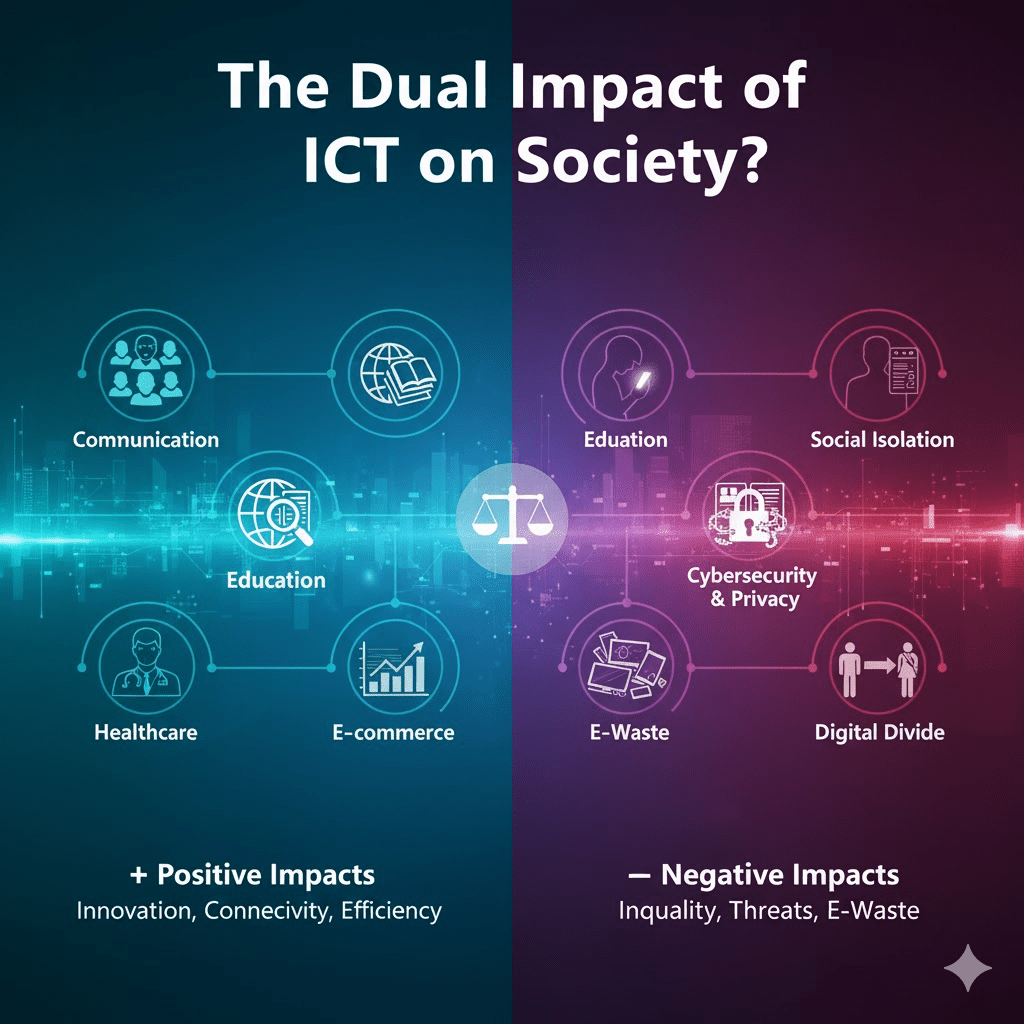
➕ Positive Impacts (Advantages)
| Sector | Impact Description | Key ICT Tools |
| Connectivity & Communication | Bridges geographical gaps, allowing instant, cost-effective global communication. Promotes social, cultural, and economic exchange. | Email, Social Media, Video Conferencing, Mobile Networks. |
| Education | Democratizes knowledge access through distance and e-learning. Provides interactive and personalized learning experiences. | MOOCs (Massive Open Online Courses), Online Research Databases, Virtual Classrooms. |
| Business & Economy | Increases productivity, streamlines operations (automation), and opens global markets through e-commerce, fostering economic growth. | ERP (Enterprise Resource Planning), E-commerce Platforms, Cloud Computing. |
| Healthcare | Enables telemedicine, remote patient monitoring, and faster diagnosis through Electronic Health Records (EHR) and AI analysis. | Telehealth Apps, Wearable Devices, AI Diagnostic Tools. |
| Governance | Improves transparency and efficiency through e-government services, allowing citizens to access information and services online (e-governance). | Online Tax Filing, Digital ID Systems, Public Information Portals. |
➖ Negative Impacts (Challenges)
| Challenge Area | Description | Concern |
| Digital Divide | The gap between those who have access to ICT (and the skills to use it) and those who do not, exacerbating existing inequalities. | Socio-economic inequality, lack of access to essential services. |
| Cybersecurity & Privacy | Increased risk of hacking, identity theft, and online fraud. Massive data collection raises concerns about surveillance and privacy loss. | Financial loss, data breaches, misuse of personal information. |
| Social & Psychological | Potential for social isolation due to excessive screen time, and the spread of misinformation (“fake news”). | Mental health, breakdown of real-world relationships, political instability. |
| E-Waste & Environment | Rapid obsolescence of hardware leads to massive amounts of electronic waste (e-waste) and significant energy consumption from data centers. | Environmental pollution, non-renewable resource depletion. |
🚀 Future Trends in ICT
The field of ICT is constant

ly evolving. Here are some of the dominant trends shaping the near future:
- Artificial Intelligence (AI) and Machine Learning (ML):
- Focus: Moving from simple automation to autonomous systems and generative content (Gen AI). AI is being integrated into every piece of software and hardware for optimization and intelligent decision-making.
- 5G and Edge Computing:
- Focus: 5G provides ultra-fast, low-latency connectivity. Edge Computing moves data processing closer to the source (e.g., a self-driving car or a factory sensor) instead of relying solely on distant cloud servers.
- Impact: Essential for real-time applications like autonomous vehicles, industrial automation, and advanced telemedicine.
- Internet of Things (IoT) Expansion:
- Focus: Connecting billions of devices—from smart home appliances to industrial sensors—to the internet, creating vast networks of data and control.
- Cloud Computing Evolution:
- Focus: Continued shift to Serverless Computing and the adoption of hybrid and multi-cloud strategies, making computing resources more flexible and scalable than ever.
- Cybersecurity Reinforcement:
- Focus: As threats become more sophisticated, cybersecurity is shifting to Zero Trust Architecture (never trust, always verify) and using AI/ML to predict and neutralize threats.
- Immersive Technologies (AR/VR/Metaverse):
- Focus: Augmented Reality (AR) and Virtual Reality (VR) are moving beyond entertainment into areas like remote training, collaborative design (digital twins), and advanced remote work environments.
Would you like a deeper explanation of one of these specific future trends, such as Artificial Intelligence or Edge Computing?
🤖 Artificial Intelligence (AI) in ICT
Artificial Intelligence refers to systems that can learn, reason, perceive, and act in ways that traditionally required human intelligence. Its impact on ICT is not about replacement, but augmentation and automation.
- Intelligent Automation: AI and Machine Learning (ML) are used to automate repetitive and complex ICT tasks, freeing up human professionals for strategic work.
- Examples: Automated help desks and chatbots for routine troubleshooting, and AI-powered network monitoring that predicts and fixes performance issues before they cause downtime.
- Enhanced Cybersecurity: AI acts as a sophisticated digital guard. It analyzes vast datasets of network traffic and user behavior in real-time to identify and neutralize threats (like malware or unusual login attempts) far faster than traditional security methods.
- Data Management & Insights: ICT is fundamentally about managing data. AI and ML are essential for processing Big Data—organizing, filtering, and defining which data is most relevant, and then generating actionable insights with greater speed and accuracy than humans.
- Personalization: AI models analyze user data to deliver highly tailored content, recommendations, and services, driving innovation in applications from e-commerce to education.
📡 Edge Computing: Faster, Closer Processing
Edge Computing is an architectural concept that moves computation and data storage closer to the physical location where the data is created or consumed—the “edge” of the network, away from distant, centralized cloud data centers.

- Minimized Latency: This is the prime benefit. By processing data locally (e.g., at a factory or on a self-driving car), the data doesn’t have to travel far, reducing the delay (latency) to milliseconds. This is critical for real-time applications like remote surgery, autonomous vehicles, and industrial robotics.
- Reduced Bandwidth: IoT devices generate massive amounts of data. Edge computing processes and filters this data locally, sending only the essential, analyzed information back to the cloud. This significantly reduces network traffic and costs.
- Improved Reliability: Operations become less reliant on a constant, perfect connection to the central cloud. Devices can continue to function and make critical, split-second decisions even with intermittent connectivity (e.g., on a remote oil rig).
- Enhanced Security & Privacy: Processing sensitive data locally at the edge limits the amount of proprietary or regulated data transmitted over the open internet.
📶 5G Networks: The Connectivity Backbone
5G is the fifth generation of mobile network technology and is the critical infrastructure enabling the growth of AI and Edge Computing within ICT.

- Ultra-High Speed: 5G offers speeds up to 100 times faster than 4G, supporting the seamless transfer of massive files (like large medical images or high-definition video streams) and high-density augmented reality applications.
- Ultra-Low Latency (URLLC): Its latency can be as low as 1 millisecond (ms), which is vital for use cases that require instant responsiveness, such as controlling robots in a smart factory or allowing for real-time remote-controlled systems.
- Massive Connectivity (mMTC): 5G is designed to connect a significantly higher number of devices per square kilometer than 4G. This capacity makes it the ideal backbone for scaling the Internet of Things (IoT) across smart cities, massive sensor networks, and smart factories.
These three trends—AI, Edge Computing, and 5G—are interconnected and foundational to the next wave of ICT development, enabling truly intelligent, instant, and pervasive digital experiences.
Would you like to explore the concept of the Digital Divide and the ethical challenges these advancements in ICT introduce?
⚖️ The Digital Divide: The Cost of Inequality
The Digital Divide is the gap between people, communities, or countries that have access to ICT and the skills to use it effectively, and those who do not. This divide reinforces existing socio-economic inequalities.

The divide is not a single problem but a series of interconnected gaps:
| Type of Divide | Description | Affected Group |
| Access Gap (First-Level) | Inequality in the physical ability to connect, often due to financial or geographical barriers. | Low-income individuals, people in rural/remote areas, developing countries. |
| Usage Gap (Second-Level) | Inequality in the skills (digital literacy) and capacity needed to use the technology effectively. | Older generations, those with lower education levels, certain minority groups. |
| Quality of Use Gap | Differences in how people use the technology. Those with higher skills use it for education, job seeking, and political engagement; others may be limited to entertainment. | Less educated or affluent individuals who miss out on the transformative benefits. |
How ICT Exacerbates the Divide
While ICT is a tool for progress, its reliance on infrastructure and cost can widen the gap:
- Infrastructure Cost: Rolling out high-speed broadband (like fiber or 5G) is expensive, leading providers to prioritize profitable urban and developed areas, leaving rural or poor regions underserved.
- Affordability: The cost of devices (computers, smartphones) and subscription fees can be prohibitive for low-income households.
- Exclusion from Services: As government, banking, education, and job applications move online (e-governance, e-commerce, e-learning), those on the wrong side of the divide are effectively excluded from essential modern life.
🛡️ Ethical Challenges of Modern ICT
The power and reach of advanced ICT—especially AI and Big Data—introduce profound moral and social dilemmas.
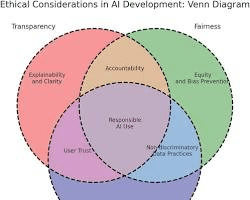
1. Privacy and Data Protection
- The Challenge: Nearly every digital interaction generates data. Organizations constantly collect, store, and analyze this Big Data, leading to concerns about surveillance, unauthorized use, and personal profiling.
- Key Concern: Who owns your data? How can we ensure confidentiality and prevent data breaches and identity theft?
2. Intellectual Property (IP) Rights
- The Challenge: The ease of digital sharing makes it simple to copy, distribute, and alter digital content (software, music, books).
- Key Concern: Protecting the rights of creators and developers through copyrights and patents against issues like software piracy and unauthorized use.
3. Bias and Fairness in AI
- The Challenge: AI systems are trained on historical data. If this data reflects societal biases (racial, gender, etc.), the AI will perpetuate and amplify those biases in its decisions (e.g., loan approvals, hiring recommendations, or criminal justice).
- Key Concern: Ensuring algorithmic transparency and developing unbiased AI that treats all users equitably.
4. Accountability and Harmful Actions
- The Challenge: It can be difficult to assign liability when a complex, autonomous ICT system, like an AI or self-driving car, makes a mistake or causes harm.
- Key Concern: Establishing clear ethical and legal frameworks to determine who is responsible for the consequences of technology gone wrong: the user, the programmer, or the company?
These challenges necessitate the development of strong Cyber Laws, Digital Citizenship education, and a commitment to Computer Ethics among professionals to ensure ICT serves humanity responsibly.
Would you like me to focus on the solutions and strategies being implemented to address the Digital Divide?
🤝 Strategies for Digital Inclusion (Bridging the Divide)
Bridging the three layers of the digital divide (access, affordability, and skills) requires a multi-pronged approach involving governments, the private sector, and civil society.

1. 🏗️ Addressing the Access Gap (Infrastructure)
The primary goal here is to treat high-speed internet as an essential public utility, not a luxury.
- Universal Broadband Initiatives: Governments launch national programs to invest in and expand broadband infrastructure, especially in rural and underserved “connectivity deserts.” This often involves massive federal or state funding, like the BEAD Program in the U.S.
- Alternative Technologies: Utilizing innovative, lower-cost technologies to overcome geographical challenges:
- Satellite Internet (e.g., Starlink) for extremely remote areas.
- Community Networks/Mesh Networks where local residents pool resources to build and maintain local Wi-Fi.
- Making Mobile More Accessible: Recognizing that mobile phones are often the primary (or only) internet access point in developing countries, efforts focus on improving 5G coverage and reducing mobile data costs.
- Public Access Points: Equipping Community Anchor Institutions (like public libraries, schools, and community centers) with high-speed internet and public-use computers to provide free access and support.
2. 💲 Addressing the Affordability Gap (Cost)
Access to the network and devices must be affordable for low-income households.
- Device Subsidies: Providing discounted or free computing devices (laptops, tablets) to low-income families and students.
- Connectivity Subsidies: Implementing programs that offer monthly discounts or subsidies on internet service plans to make them accessible (e.g., the Affordable Connectivity Program in the US).
- Promoting Competition: Regulatory policies that encourage competition among Internet Service Providers (ISPs) to naturally lower consumer prices.
3. 🧠 Addressing the Usage Gap (Digital Literacy and Skills)
Providing the technology is useless if people don’t know how to use it safely and effectively. This focuses on building Digital Literacy.
- Targeted Training Programs: Developing specialized digital literacy curricula tailored to different demographics, such as:
- Seniors: Focused on online health services, social connection, and protection against scams.
- Job Seekers: Focused on resume building, online applications, and digital collaboration tools.
- Teachers: Training teachers to effectively integrate ICT into their pedagogy (teaching methods).
- Inclusive Content: Ensuring that online information, applications, and e-government services are available in local languages and are accessible to people with disabilities (e.g., screen reader compatibility, multilingual support).
- Digital Citizenship: Teaching skills beyond basic use, including critical thinking (identifying fake news), online safety and cybersecurity awareness, and understanding digital footprints.
4. 🤝 The Role of Collaboration
Effective solutions rarely come from one sector alone. Public-Private Partnerships (PPPs) are essential.
- Government’s Role: The government’s primary role is to act as the regulator and equalizer, providing the strategic vision, necessary funding (often leveraged from the Universal Service Funds), and clear policy direction.
- Private Sector’s Role: Telecommunication and tech companies bring the innovation, expertise, and capital required to deploy new technologies (5G, fiber) efficiently.
- Civil Society’s Role: NGOs and local community groups provide the crucial, on-the-ground support, delivering customized training and managing local access centers, ensuring solutions are relevant to the community’s specific needs.
By combining efforts across these four areas, the goal of Digital Inclusion is to ensure that ICT serves as an engine for equitable development rather than a source of further division.
💰 The ICT Sector: An Economic Powerhouse
The ICT Sector is the segment of the economy that produces goods and services that process, transmit, or display information electronically. It is a vital driver of global economic growth and productivity.

Economic Significance
- Innovation Engine: The ICT sector is the primary source of innovation globally, constantly creating new technologies, products, and services that transform other industries (a process called digital transformation).
- Investment Magnet: It attracts massive investment in research and development (R&D), capital expenditure on infrastructure, and mergers/acquisitions.
- Productivity Growth: By providing tools for automation, efficient communication, and data analysis, ICT is responsible for significant productivity gains across nearly every other industry sector.
🏭 Classifications of the ICT Industry
The ICT sector can be broadly divided into four key industrial groups based on the products and services they offer:

1. ICT Manufacturing (Hardware)
This group focuses on the physical production of technology components and end-user devices.
- Products: Computers, networking equipment (routers, modems), mobile devices (smartphones, tablets), microprocessors (CPUs, GPUs), electronic components, storage media (SSDs, hard drives).
- Key Companies: Chip manufacturers (e.g., Intel, NVIDIA), device assemblers (e.g., Samsung, Apple, Dell).
2. ICT Services (Software and Operations)
This is the largest and most diverse segment, encompassing all non-physical products and support.
- Software Development: Creating and maintaining operating systems, enterprise applications (e.g., ERP, CRM), security software, and cloud services (SaaS).
- IT Consulting & Outsourcing: Providing expertise, strategic planning, systems integration, and managing IT operations for other businesses.
- Data Processing: Managing, storing, and analyzing large volumes of data (Big Data services, Cloud Hosting).
3. Telecommunications Services (Connectivity)
This group focuses on building and managing the networks that transmit data.
- Wired & Wireless Services: Providing internet access (broadband, fiber optic), mobile voice, and data services (4G/5G).
- Infrastructure Management: Operating satellite networks, undersea cables, and maintaining cellular towers.
4. Content and Media
This segment focuses on the creation and distribution of digital content, relying heavily on ICT infrastructure.
- Digital Publishing: E-books, online news media.
- Broadcasting: Internet-based video and audio streaming (e.g., Netflix, Spotify).
- Interactive Entertainment: Video game development and distribution.
💼 Career Paths in ICT
The demand for skilled ICT professionals is consistently high across the globe. Careers in this field generally fall into the following domains:

| Career Domain | Focus Area | Example Roles |
| Development & Engineering | Creating and maintaining software, systems, and code. | Software Developer, Network Engineer, Cloud Architect, Data Scientist. |
| Data & Analytics | Collecting, organizing, interpreting, and visualizing large datasets. | Data Analyst, Business Intelligence (BI) Analyst, Database Administrator. |
| Security | Protecting systems, networks, and data from threats. | Cybersecurity Analyst, Ethical Hacker, Information Security Officer (ISO). |
| Infrastructure & Operations | Managing hardware, networks, and IT support systems. | System Administrator, Help Desk Support Specialist, IT Project Manager. |
| Strategy & Management | Aligning ICT initiatives with business goals and managing teams. | Chief Information Officer (CIO), IT Manager, Technology Consultant. |
Md. Abdullah Rahman
Computer Science and Technology .